What is Resale Royalty Rights (Visual Arts) — RRRVA?
Resale Royalty Rights (Visual Arts) — RRRVA, also known as RRR, are a type of intellectual property rights (IPR) protection that is presented to creators of visual art under the copyright system. The Resale Royalty Rights (Visual Arts) — RRRVA program provides visual artists and their heirs with the opportunity to retain an interest in any repeated commercial resale of their artwork and to receive a portion of the proceeds from the sale of the artwork.
Albert Vaunois first introduced the concept of the Droit de Suite in an essay that was published in the Chronique de Paris in the year 1893. After that, Edouard Mack, a French lawyer, brought up the question of Droit de Suite in his report that he submitted to the Bern Congress of the International Association of Arts and Arts in the year 1896 (O'dwyer, A., 2018).
KEY FACTS
- → First established in France in 1920
- → EU Directive: 4% royalty on resales above €400
- → Right is inalienable — cannot be waived
- → Passes to heirs for 70 years after death
ELIGIBILITY
- — Original works of visual art
- — Paintings, drawings, sculptures
- — Engravings and photographs
- — Resale above minimum threshold
Who Has Implemented RRR?
Since 2014, the International Confederation of Societies of Authors and Composers (CISAC) and others have been actively campaigning to push the issue of the artist's resale right up the international copyright agenda, calling for reform of the law so that visual artists benefit each time their work is resold (Jewell, C., 2017).
In most countries in Europe, Resale Royalty Rights (RRR) are implemented through national legislation or through the implementation of the European Union Directive which requires member states to implement Artist's Royalty Resale Rights (ARRR) for those living in the region. The percentage of royalties received by each artist usually depends on the selling price of the artwork (Scown, S., n.d.).
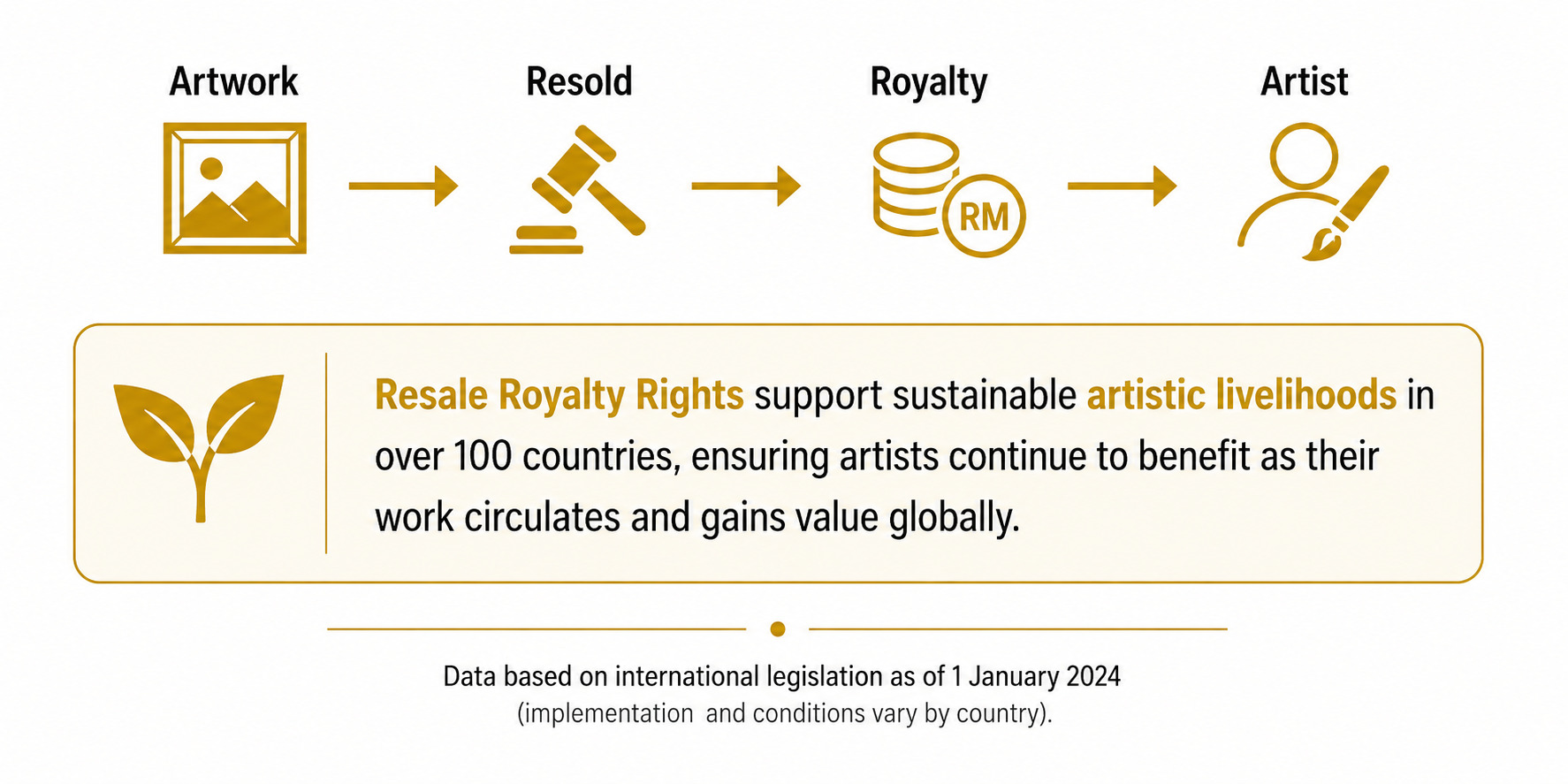
In addition to the European Union, several other countries have also adopted this concept of Resale Royalty Rights (RRR) in their laws. For example, Australia, China, Japan, and even some countries in parts of the United States. However, each country has different variations in terms of its laws and conditions. According to (EuropeanVisualArtists, 2024) more than 106 countries have a provision for the Artist's Resale Right in their legislation as of 1st January 2024.
Therefore, Artist's Royalty Resale Rights (ARRR) could and should become a consistent source of revenue for artists and their heirs. This becomes even more possible when more countries adopt the right and widen the geographical range of remuneration via reciprocity. It is important to note that despite the varying terminologies, the emphasis should lie on what all these terms represent, which is the nonwaivable right to a percentage from the resale of an artist's work, which can be perceived as either a remuneration or a royalty (EuropeanVisualArtists, 2023).
EU Member States
All 27 EU countries implement Directive 2001/84/EC with royalty rates up to 4%.
Artist's Resale Right (ARR)
In force since 2006, managed by DACS. Applied to resales above £1,000.
Resale Royalty Scheme
5% royalty on resales of AU$1,000 or more. In force since 2010.
Droit de Suite (Origin)
Birthplace of resale royalty rights. First enacted in 1920.
California Resale Royalty
State-level 5% royalty. Federal implementation under ongoing discussion.
Growing Adoption
Senegal, Tunisia, Brazil, Mexico and more have implemented versions of RRR.
Countries Implementing Resale Royalty Rights
countries
worldwide have provisions for Artist's Resale Rights in their legislation.
Resale Royalty Rights are mandatory across most European countries.
Countries such as Australia, Brazil, Russia, and parts of US have also adopted resale royalty rights.
Artists do not currently benefit from secondary market resales.
Tap image to enlarge
How Resale Royalty Rights Work
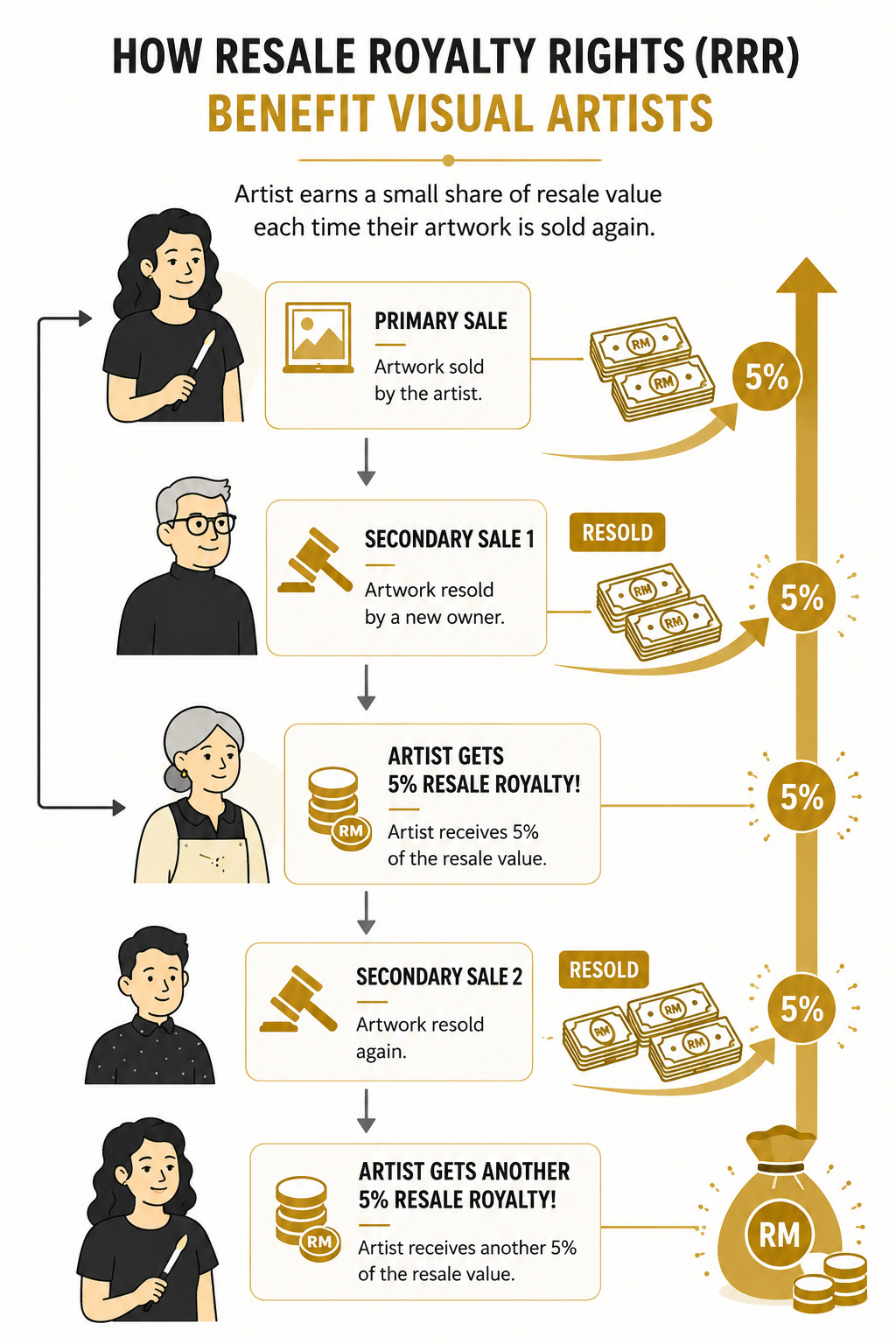
This diagram illustrates the life cycle of an artwork as it moves through the primary and secondary art market, and how Resale Royalty Rights (RRR) allow artists to continue benefiting from the increasing value of their work.
Tap image to enlarge
At the primary sale, the artist sells the artwork for the first time and receives 100% of the sale price. Ownership of the artwork is transferred to the buyer, and under most existing systems, the artist's income from that artwork ends at this point.
As the artwork enters the secondary market, it may be resold multiple times through galleries, auctions, or private collectors. With each resale, the value of the artwork often increases. However, without resale royalty rights, the artist is not involved in these transactions and does not receive any share of the resale value.
When Resale Royalty Rights (RRR) are applied, a small percentage of each resale price is returned to the artist. As shown in the diagram, every time the artwork is resold, a portion of the transaction flows back to the artist as a royalty. Over time, these repeated royalties can become a meaningful source of ongoing income.
This model highlights how RRR support fair compensation, ethical market practices, and the sustainability of artists' livelihoods, while allowing artworks to continue circulating freely within the art market.
Original Sale
Artist sells original artwork. Resale right is not triggered at this first sale.
Subsequent Resale
Artwork resold through auction or gallery above the minimum threshold.
Royalty Calculation
A percentage (3–5%) of the resale price becomes due to the artist.
Collection & Distribution
A CMO collects and distributes the royalty to the artist or their heirs.
Why RRR Matters
For Artists
Provides an ongoing income stream and ensures artists benefit as their market value grows.
For the Art Market
Promotes transparency and ethical conduct, building trust between all stakeholders.
For Malaysia
Positions Malaysia as a progressive, artist-friendly nation aligned with global IP standards.