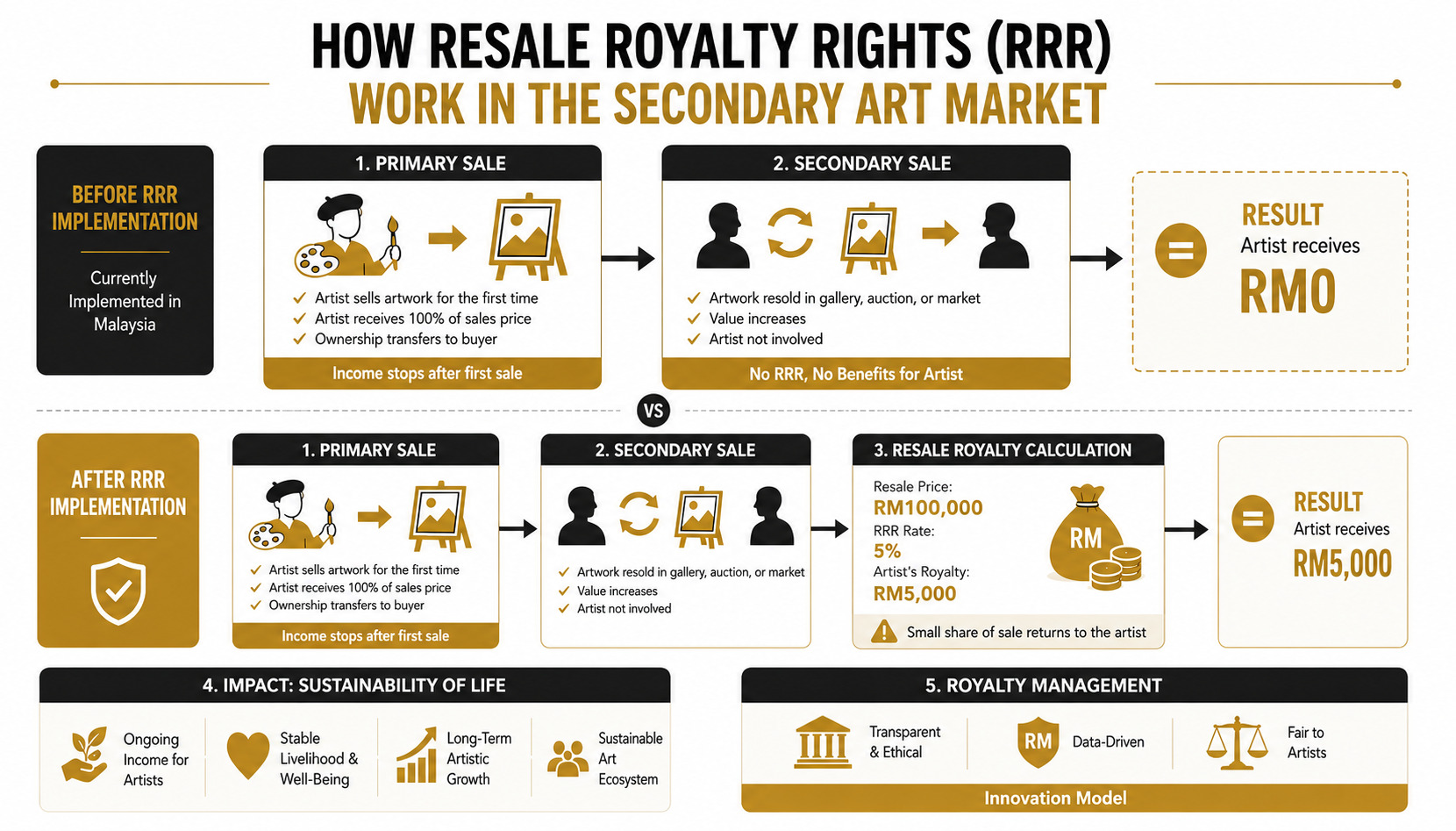
This simulation illustrates how Resale Royalty Rights (RRR) operate within the secondary art market. It shows what happens to an artwork after the first sale and how artists can continue to benefit from the increasing value of their work when resale royalties are implemented.
Why Royalty Simulation?
Many visual artists are unaware of what resale royalty rights could mean for their livelihood. The gap between an artwork's original sale price and its eventual resale value in the secondary market can be significant — and under a proper RRR system, artists would share in that gain. This tool helps artists, collectors, galleries, and policymakers understand the financial impact of resale royalty rights.
How Resale Royalty Rights Work
Current situation in Malaysia
The artist sells the artwork for the first time through a gallery or directly to a collector, receiving 100% of the sale price. Physical ownership transfers to the buyer.
After this point, the artist no longer earns income from the artwork.
When the artwork is resold, its value often increases. However, the artist is not involved and receives no share of the resale value.
Proposed implementation
A small percentage of the resale price is returned to the artist each time the artwork is resold. This royalty does not prevent resale — it simply ensures fair participation.
Even small resale royalties make a meaningful difference over time. Artists gain access to ongoing income, supporting their livelihood, well-being, and long-term creative practice.
For resale royalties to work effectively, they must be managed through transparent, ethical, and data-driven systems. This ensures fairness for artists while maintaining trust across the art market.
This platform simulates an ideal royalty governance model for learning, policy discussion, and innovation.
Illustrative Simulations (Before & After) Implementation of RRR
The Strategic Gears of RRR
The "Strategic Gears of RRR" illustrates how a coordinated system of governance, policy, and implementation strategies work together to advance the effectiveness of Resale Royalty Rights (RRR). At the core lies the societal mission: to promote artists' economic justice while ensuring the long-term sustainability of the creative sector.
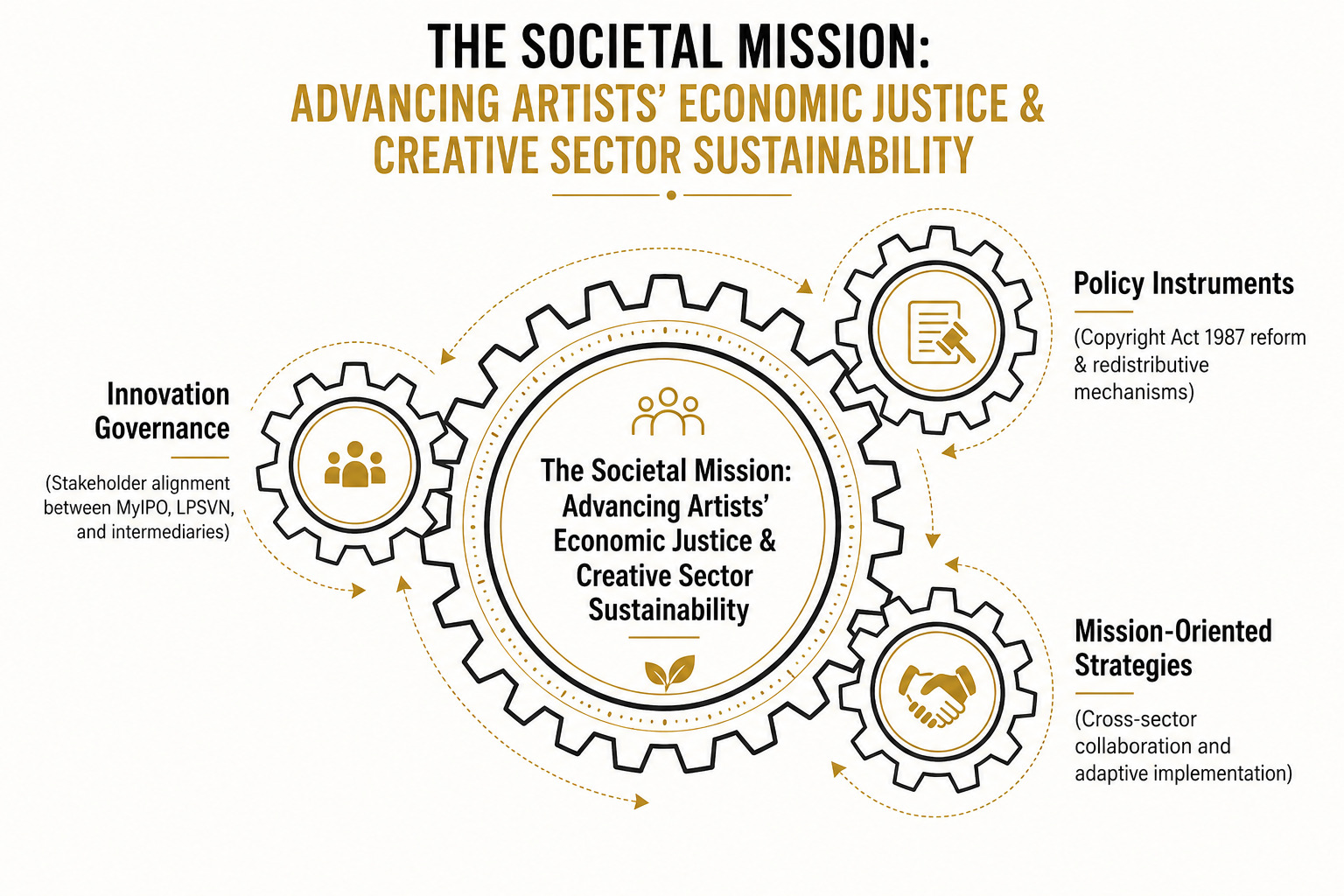
Driving this mission are three interconnected components. Innovation Governance focuses on aligning key stakeholders including MyIPO, LPSVN, and market intermediaries to ensure cohesive regulation, transparency, and efficient royalty distribution. Policy Instruments provide the legal and structural foundation, particularly through reforms to the Copyright Act 1987 and the introduction of redistributive mechanisms that safeguard artists' rights in the secondary market. Meanwhile, Mission-Oriented Strategies emphasize cross-sector collaboration and adaptive implementation, enabling the system to respond to evolving market conditions and technological developments.
Together, these strategic "gears" function as an integrated ecosystem, ensuring that RRR is not only implemented effectively but also continuously improved to benefit artists and strengthen the broader art economy.
Advancing Artists' Economic Justice
The core mission of RRR is to promote economic justice for visual artists and ensure long-term sustainability of the creative sector — recognising artists’ ongoing contribution to cultural and economic value.
Stakeholder Alignment
Aligning key stakeholders — MyIPO, LPSVN, and market intermediaries (galleries, auction houses) — to ensure cohesive regulation, transparency, and efficient royalty distribution across the art market.
Legal & Structural Foundation
Reform of the Copyright Act 1987 to explicitly recognise visual artists as royalty recipients, with introduction of redistributive mechanisms — minimum resale thresholds, rates, and compliance obligations.
Cross-Sector Collaboration
Adaptive implementation through cross-sector collaboration between arts bodies, legal experts, technology providers, and policymakers — enabling the system to evolve with market conditions and digital developments.
Digital Infrastructure
Artist registries, digital artwork provenance tracking, automated royalty calculation engines, and a compliance reporting portal for galleries and auction houses.
Oversight & Enforcement
A regulatory framework empowering MyIPO and LPSVN with mandate to enforce compliance, conduct audits, resolve disputes, and continuously refine the RRR policy based on outcomes and stakeholder feedback.
The Missing Link — CMO (Visual Arts)
Within the current regulatory vacuum of the secondary art market, the Collective Management Organization (CMO) emerges as the critical missing link in ensuring the effective implementation of Resale Royalty Rights (RRR). It serves as the institutional bridge connecting primary creators and rights holders with key market players such as galleries, auction houses, and collectors.
Findings from this research — drawing on insights from five key stakeholder groups — highlight that a CMO is not just beneficial, but essential as a central coordination mechanism. Modeled after established music royalty systems such as RMP and MACP, a CMO would be mandated to centralize royalty collection, management, and distribution in a structured and transparent manner.
By doing so, the CMO significantly reduces the administrative burden currently placed on individual galleries and auction houses, allowing them to focus on market activities while ensuring compliance with royalty obligations. More importantly, it guarantees that artists continue to receive fair economic returns from the resale of their works.
In essence, the CMO completes the RRR ecosystem — transforming a fragmented system into a cohesive, efficient, and sustainable framework that upholds artists' rights and strengthens the integrity of the art market.
Organization (CMO)
collection or distribution
Institutional Readiness
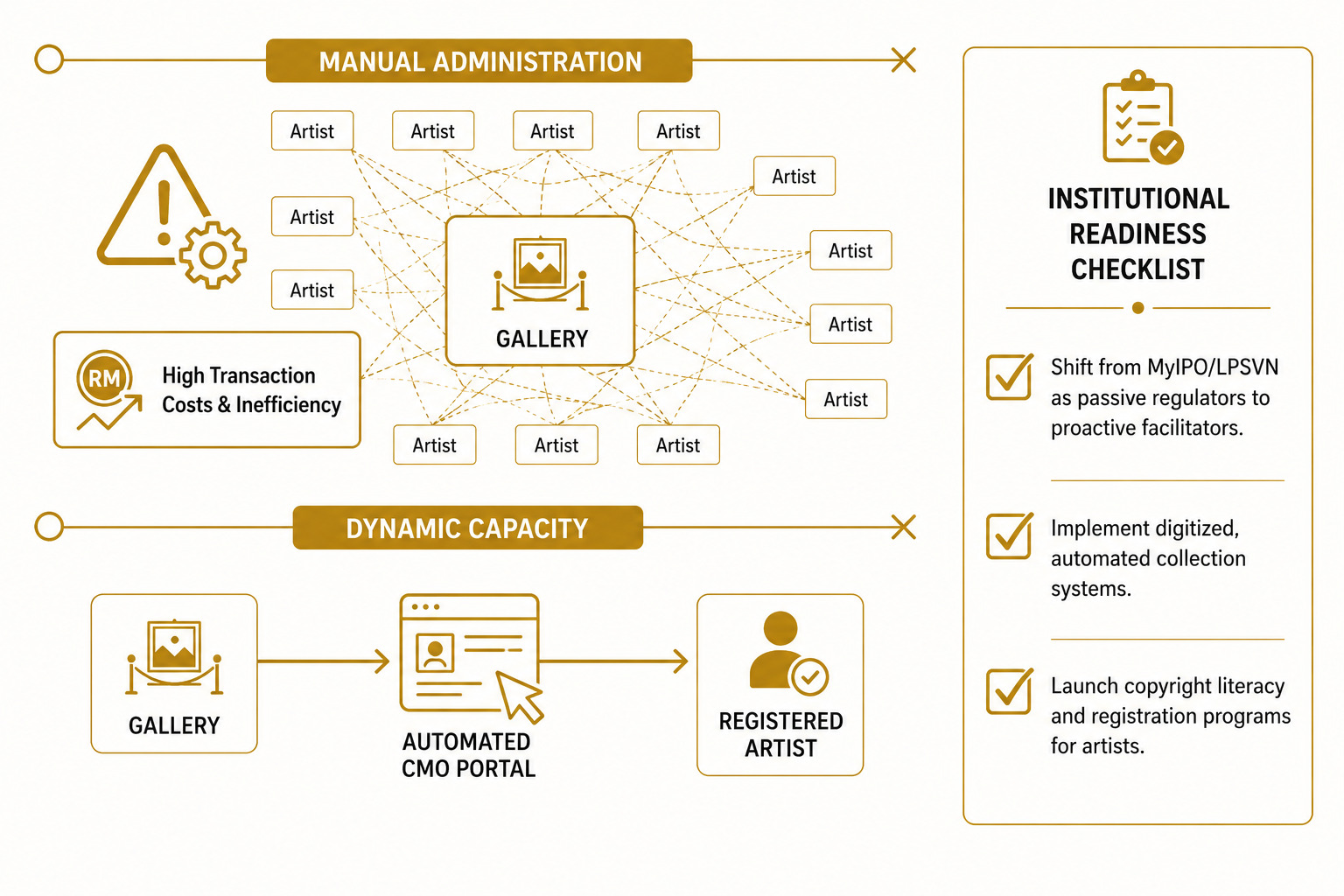
Institutional readiness is a critical foundation for ensuring the effective and sustainable implementation of Resale Royalty Rights (RRR). At present, the system is largely dependent on manual administration, where galleries manage multiple artist transactions independently — resulting in inefficiencies, fragmented processes, and high transaction costs.
Tap image to enlarge
To overcome these limitations, a transition towards a Dynamic Capacity approach is essential. This model reconfigures the system into a more streamlined and connected ecosystem, where galleries interact directly with an Automated CMO Portal. Through this centralized digital platform, processes such as royalty reporting, collection, and distribution can be managed more efficiently, transparently, and in real time.
Achieving institutional readiness requires several key shifts. First, regulatory bodies such as MyIPO and LPSVN must evolve from passive regulators into proactive facilitators, actively supporting coordination, compliance, and system innovation. Second, the implementation of digitized and automated collection systems is necessary to reduce administrative burdens and enhance operational efficiency. Finally, the introduction of copyright literacy and registration programs for artists is crucial to ensure awareness, participation, and empowerment within the RRR framework.
Together, these elements form a comprehensive readiness strategy — transforming a complex and inefficient system into a responsive, integrated, and future-ready infrastructure that supports artists and strengthens the creative economy.