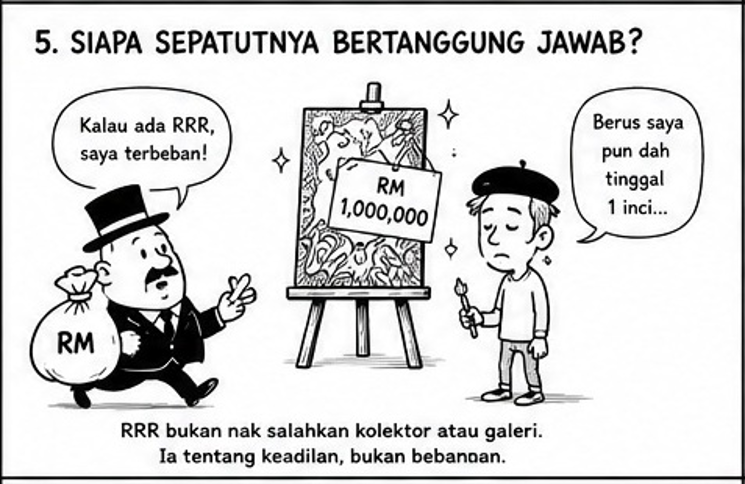
This article discusses the Resale Royalty Right (RRR) as part of a broader effort to build a fairer, more transparent, and more sustainable visual arts ecosystem in Malaysia. Drawing on the realities of the secondary art market, particularly the appreciation of artworks after their initial sale, the author positions RRR not merely as an economic mechanism, but also as a form of social and cultural recognition of the continuing relationship between artists and the works they create.
This article discusses the Resale Royalty Right (RRR) as part of a broader effort to build a fairer, more transparent, and more sustainable visual arts ecosystem in Malaysia. Drawing on the realities of the secondary art market, particularly the appreciation of artworks after their initial sale, the author positions RRR not merely as an economic mechanism, but also as a form of social and cultural recognition of the continuing relationship between artists and the works they create.
The discussion emphasises that the implementation of RRR should be considered with future generations of artists in mind and supported by government policy, legislation, incentives, and more transparent market practices. The author also argues that resale royalties should be associated with successful secondary-market gains without framing collectors or buyers as adversaries within the art ecosystem.
As an alternative hypothesis, should formal RRR legislation remain unavailable, the article proposes the development of a stronger culture of documentation beginning from the first sale. A central proposal is the introduction of an Artwork Provenance Certificate, or an “artwork birth certificate,” recording the artist’s identity, artwork details, initial sale price, gallery information, ownership history, and any agreed terms relating to future resale royalties. Such a document could serve as a continuous record accompanying the artwork as it moves from one owner to another.
Overall, the article argues that whether or not RRR is eventually enacted into law, stronger systems of documentation, provenance, sales contracts, and ownership records are essential to the development of a more mature visual arts ecosystem. The issue extends beyond the distribution of financial gains to encompass artistic dignity, historical continuity, market transparency, and the recognition of visual art as part of the nation’s intellectual and cultural heritage.
Read original article here : https://kolumpoart.com/2026/07/24/perihal-ekosistem-seni-visual-tanpa-pelaksanaan-hak-royalti-jualan-satu-hipotesis-alternatif/
Image credit : kolumpoart.com