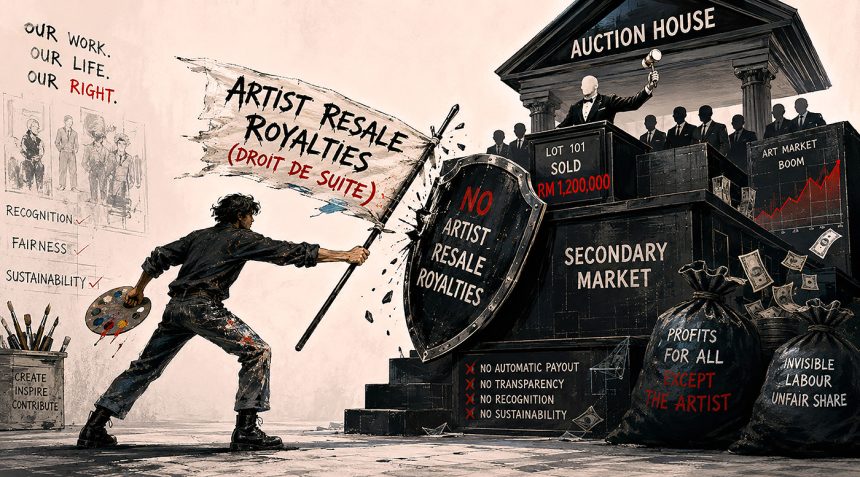
This article examines the need to introduce the Resale Royalty Right (RRR) within Malaysia’s visual arts ecosystem as a mechanism that would allow artists to receive a share of the economic benefits generated when their works are resold on the secondary market. The issue arises from an existing imbalance in which the appreciation of an artwork after its first sale primarily benefits owners, collectors, auction houses, and other market participants, while the original creator receives no further return from subsequent transactions.
This article examines the need to introduce the Resale Royalty Right (RRR) within Malaysia’s visual arts ecosystem as a mechanism that would allow artists to receive a share of the economic benefits generated when their works are resold on the secondary market. The issue arises from an existing imbalance in which the appreciation of an artwork after its first sale primarily benefits owners, collectors, auction houses, and other market participants, while the original creator receives no further return from subsequent transactions.
Drawing on an analysis of resale transactions involving works by Awang Damit Ahmad through Henry Butcher Art Auctioneers between 2010 and 2025, the article demonstrates that Malaysia’s secondary art market has developed sufficiently to generate significant economic value. These findings suggest that the discussion surrounding RRR is no longer purely theoretical, but is increasingly relevant to the practical realities of the local art market.
The article also considers international RRR practices alongside insights gathered from a series of discussions involving visual artists, gallery owners, collectors, academics, and intellectual property practitioners. The findings indicate that effective implementation in Malaysia would require more than legislative reform alone. It would also depend on clear governance, transparent royalty collection and distribution mechanisms, an effective digital infrastructure, and stronger awareness among key stakeholders.
Overall, RRR is presented not only as an economic mechanism, but also as a form of recognition for artists’ creative contributions and an instrument of cultural justice. Its implementation could contribute to a fairer, more sustainable, and more inclusive visual arts ecosystem in Malaysia while ensuring that artists continue to benefit from the long-term value created by the works they originally produced.
Read original article here : https://senimalaya.com/3r-mahu-tunding-jari-atau-harus-mula-melobi/